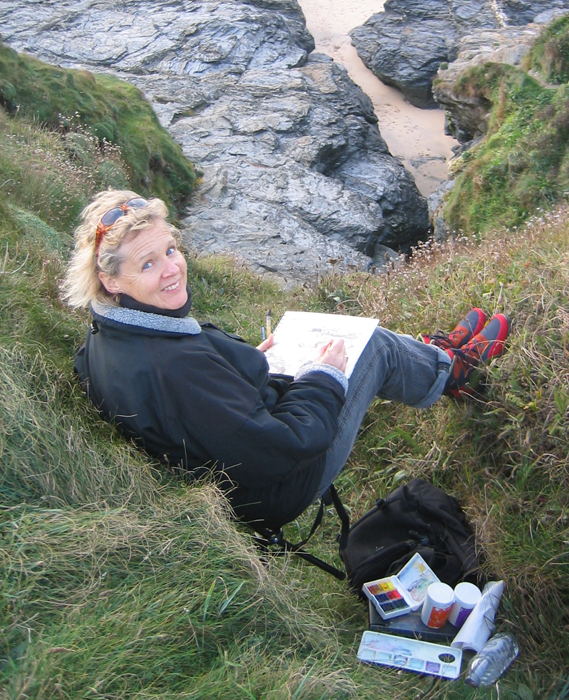
I was born and raised in Scotland and despite having lived elsewhere for many years, I find myself continually drawn back to the Highlands, particularly the Western Isles where as a teenager, I spent many a holiday sailing between the islands and exploring the coastline. To this day, I love walking and sketching out in the landscape where I can observe the wildlife, collect shells and go beachcombing along the silver sands, breathing in the atmosphere.
As I continued my sailing adventures into adulthood, I was fortunate to be given the chance to crew in the Clipper Round the World Yacht Race. I had often wondered what it might be like to make an ocean crossing and so I jumped at the chance and embarked on the adventure of a lifetime, crossing not just one, but all the world’s oceans as I completed a circumnavigation. The many hours spent on watch looking out towards the horizon are etched in my memory. It is these images that invariably find their way into my paintings and prints, whether consciously or otherwise. I especially like to evoke the ever-changing weather, which at sea can sometimes be quite extreme, creating unexpected light effects and visual excitement.
When I’m not travelling or working on location, I will be in my studio working mainly on still-life projects. I usually begin by making working sketches from my container collection and develop the painting from there. I may incorporate flowers or objects which evoke a past memory or a narrative and more othen than not, I find myself incorporating a window or a view of the sea, which has always held strong connections and memories for me.
From the working drawings, the painting evolves as I experiment and try out different configurations and possibilities until I am satisfied with the composition. I really enjoy this process because I am never quite sure how a painting will turn out. I enjoy the excitement of ‘not knowing’ as I add or subtract elements along the way until the final painting is resolved. Sometimes it can become a struggle, in which case I will leave it for a day or so and turn to another painting. I usually have several on the go at the same time which helps me to keep each one alive and fresh. In this way I can return to work on a painting with a renewed eye and a clearer sense of how to develop a painting to a satisfactory conclusion.